Hello, loves!
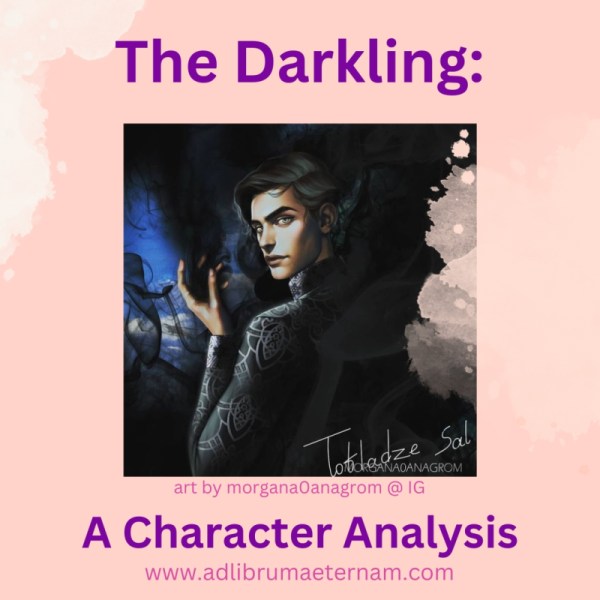
This analysis of the Darkling/Aleksander Morozova is based ONLY on the Shadow and Bone book series by Leigh Bardugo! I did not include King of Scars nor Rule of Wolves (also by Leigh Bardugo), nor the Netflix series. I wanted to stay true to what we’d first seen of him and how we got to love-and-hate him at first.
With that in mind, are you curious to discover perspectives or aspects you perhaps hadn’t thought about? And to delve deeper into understanding this essential and beloved (sometimes hated) character?
Then, read right on!
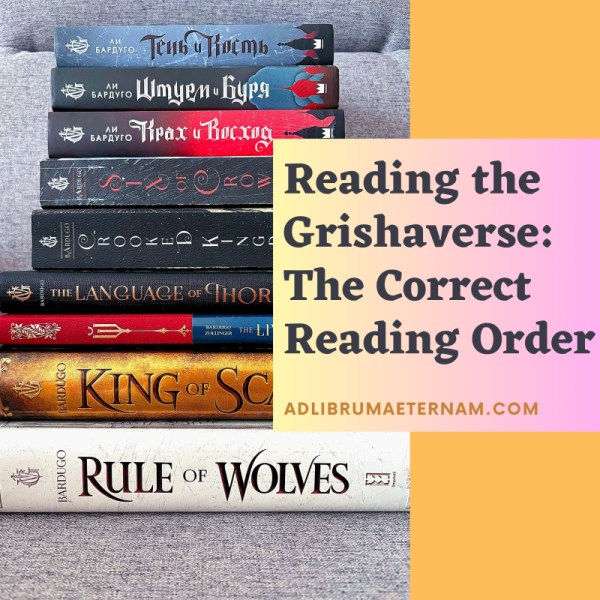
(In case you're trying to figure out how to read the Grishaverse in the correct order, I've got you!)
His Beginning
Aleksander Morozova wasn't always a villain. Okay, he was born with the Shadow Summoning ability, just like his mother, Baghra, but he wasn't heartless nor mean. In the short story and graphic novel Demon in the Wood, he was just a young man of 15, like any other teenager, and he dreamed of having friends and a steady place he could call "home". He rejoices at the idea of staying a few months in the same place, despite being hunted as a rare Grisha (and an amplifier!) with his mother. And when he started to befriend a girl, who seemed to like him, and he liked her back, ordinary adolescence stages came through: he fancied her, and he wanted friends. Does that sound mean to you? No.
He also entertained his friend's littler sister with his powers; and defended them from the village's bullies. He just yearned for a safe place. For himself, his mother, and the Grisha who had to live in desolate places and ruins, or secluded because of their powers. And they were hunted, constantly, every one of them.
It's quite reminiscent of the witches and witch hunts. Were the witches bad? No. But the hunters and the Inquisition sure were, burning and killing people (and even cats!) without an ounce of remorse. Most of the time, witches often helped people in the villages with their remedies… and they got killed for it. Which is similar to the Grisha, albeit their powers are more demonstrative.
When Aleksander saw his life being dealt between two Grisha teens to become more powerful and have a chance at survival (since he's an amplifier, and if they wear his bones, their powers will increase), he understood there was no safe place for people like them. They were driven to despair. His mother wasn’t even angry that these children tried to kill her son for it–she understood them because it's such a rough life. And so, Aleksander realized that someone needed to create this safe place for his own kind–and he vowed to be the one to do it. Because he’d experienced first-hand how despair drives the Grisha to do horrible things to each other, and how much they’re hunted and must live in fear.
So far, so (not) good.
Merzost and Losing Himself
However, he did spend centuries learning and climbing the social ranks, faking his death here and there to be born anew so no one would suspect him. He vouched for this safe place, and put all his knowledge and power and social ranking to this purpose that drove him. Sadly, the Darkling turned to merzost, which is the magic at the basis of all things, and forbidden because the cost is high. Using it, he created the Fold, a long and wide space full of people-turned-monsters, all darkness. He'd started losing his way by looking for such desperate means such as merzost from Morozova's books, but his intention was good. He wanted to help and protect his people, who were still hunted and despised.
But after the creation of the Fold, he became a general to the king of Ravka, where Grisha serve in the Second Army (the army of those with powers), where it's a bit more acceptable to be a Grisha, though still not entirely accepted. And he started losing himself quite a lot, by offering a preteen girl to the queen knowing full well how the king was dirty… by killing people and other Grisha, by manipulating his own and lying his way to power.
His Hope and Love for Alina (and His Mother, Baghra)
Then, Alina arrived.
He viewed her both as a hope, a grand hope for the Grisha, and a threat. Because if she was not on his side, she could fight him and that would be disastrous as it would threaten everything he ever fought for. And as a grand hope, because she could help him with the Fold, help him make it greater so he could create a haven for Grisha. Also, he saw her as an equal. Because besides his mother who also wielded the shadows, Alina was the only other like him, she’s a Sun Summoner, a rarity, like he was the only Shadow Summoner with merzost command. They were the strongest and the rarest of the Grisha.
The worst part is she was with an otkazats'ya, a commoner with no power. Exactly the kind of people who hunted and killed The Darkling's Grisha throughout the centuries, and why Grisha have been pushed to despair. So this was not only insulting, but a thorn on his side.
Another point that made it difficult for Darkling to bond with Alina was how reluctant she was about the whole Sun Summoner ordeal that befell her. I mean, I get her, she wanted a normal life making maps and being with her childhood friend, ok. But she was something else–she was a rare Grisha, viewed as a saint. Although, I admit, it's never easy to embrace one's destiny when it doesn't fit with what you wanted in the first place. Nevertheless, Darkling had to work harder to make her see she was truly that important. Just like when the Darkling told Genya to withhold Mal's letters to Alina, because she hoped for him to write to her… Why? Because the Darkling said Mal, an otkazats'ya, was part of an old life, one where Alina wasn't that important nor Grisha. In truth, he was not so wrong, because oftentimes Mal didn't understand how the people relied on her and looked up to her, nor how being Grisha means to love one's powers and be attracted to said power. Mal often tormented her by being untruthful, moody, lashing out at her, when all she needed was comfort and to be asked "why" she said that or acted this way. But he didn't, he just assumed things, bad things about her. When she was traumatized. Boo hoo, poor guy feels forgotten and useless… Alina was experiencing hell in Ravka and her mind, but sure, pout about it and make her feel worse. That's the way to go.
At least the Darkling always saw her. For her potential, yes, but also as an equal, another Grisha. Not one to be scared of, not like Mal. Mal doubted Alina here and there, and thought Grisha were scary and dangerous… But the worst part of his character was that he alienated Alina often, almost every time they talked. Why? Because he went with other women, and suddenly when Alina was important, AH, now he'd always wanted her. He also left her alone, not really worrying about her. And when the Darkling played with Alina's mind in quite direct ways, Mal pouted, snapped at her, stayed by her side as a guard but clearly resented her with his silence AND he kissed Zoya even though he was dating Alina. Just to get back at her, because Mister is so forgotten. But Alina lived through being the Chosen One, being played with, and was still being played with in her mind and she thought she was going mad, and she was afraid and traumatized. She needed support. And who wanted to be there for her? Albeit in a weird way, yet with open arms? The Darkling. He knew how lonely it can get, being this powerful.
But then after the Darkling's plan of which Alina escaped (thanks, Baghra!), Alina just wanted to defeat him. Yet, the Darkling was mad at her, but he wanted to force her into his arms and vicinity, until there was no shelter but him. That was not healthy affection, but he still reached out to her. But he also became angry and more violent, more desperate, because she wasn't on his side anymore, the right side, to help Grisha. This made her an enemy, and yet he tried to make her see that Mal wasn't good for her, nor common people. That she was siding with those who burned Grisha at the stakes for centuries and more. He was just trying to make her understand he was trying to help them, but since she didn't want to hurt people, and was hurt by his betrayal of his plan, she didn't give him reason. Sometimes, she felt attracted to him and his ideas, the power of it, but she fought against it. I love this side of Alina, which gives her a greater tangibility and reality. She's mostly white, but a lot of grey too. She, just like the Darkling, went to great lengths to protect those she loved. And that makes her more than his match in all the ways. She even lost her own power to end his reign. He made a lot of sacrifices, of people, of opportunities, of parts of himself, too… Just like her. And he was right, the only person to truly understand her was him, and she'd be left alone if she killed him.
I think the way Mal brooded against her didn't help her inclination to the Darkling. Because when she was at her most vulnerable, Mal was mean to her, and the Darkling came to discuss and somehow make her see how wrong she was about all of them. Darkling probably did this for himself, for somewhere he knew what it was to be reviled and wanted for something you were, like the girl he liked who tried to kill him to survive. With otkazats'ya, once more. Always the normal ones against the Grisha.
Despite all of this spite and fight between Darkling and Alina, in the end, the Darkling wanted her to be close as he was dying, and he offered her a piece of himself he held secret for centuries: his true name. That cannot mean that she was unimportant. He kept his real name secret for centuries, only to say it to one person only, the one rival he esteemed, the one woman he truly desired. And if he hadn't lost himself along the path to saving the Grisha by creating a haven for them, the one woman he'd have loved.
His mother, Baghra, when Aleksander was only 15 years old, had warned him to disclose his true name only to someone who was very meaningful to him. Because since they changed places often, he had to change names as well. And he felt like his true name, Aleksander, was getting lost among all those changes… But his mother told him his name was engraved on his heart. So, logically, only someone who was important to him or that he loved or both would get to learn his real name.
On a side note, which is essential to his character, Aleksander loved his mother, Baghra. He did mistreat her by making her blind, true, yet he always kept her by his side despite their differences on his grand plan for Grisha. When he was at the Little Palace, she was there. When she betrayed him by helping Alina, he made her blind to punish her, yet he did not kill her. He wanted his mother close and alive. They had lived so many centuries and survivre so many dangers together, this clearly meant something to him. And when Baghra jumped to her death, Aleksander rushed after her body, instantly focusing on her while not caring about Alina anymore. He became more vile and unstable after Baghra’s death. Although he was was dangerous and seemingly heartless, he deemed his mother important enough to keep her close and go after her as she fell to her death. Aleksander is complex, and he kills in the name of making a safe haven for Grisha—he sacrifices a few of their own as well, like poor Genya, giving her as a child to a mean queen with a dirty king he was well aware would take advantage of Genya—but part of that comes from having followed his mother around younger, when they had to hide their identities, lie their way through an ounce of safety at a time, and fighting anyone to stay alive. He grew up suspicious, terrorized. But he knew Baghra was reliable and trustworthy, and that she loved him enough to teach him how to survive against all odds. So losing her was like losing an old and steady pillar of his life—the only one to stand the test of time. Aleksander needed her; the boy within loved his mother to the end. Her death made an impact on him, and that’s part of what’s love’s about. And monsters can’t love. But Aleksander did.
Upon dying, he disclosed his true name to Alina, asking her to say it one last time. He wanted to hear his true self reflected back to him upon dying. It seems like he suffered from having to hide constantly and being this all-powerful tyrant, when his basis was just a young man who wanted friends and a steady life. And he wanted to hear it said back to him, by someone he (probably) loved and who was meaningful to him. I think it's quite significative that he chose to tell it to Alina out of all people; he had collaborators, henchmen, and lovers… but never anyone who mattered enough to him to disclose his real name. Except Alina Starkov. Because she was like him, in a way. A soul lost in a world she just wanted to stop and live her life ordinarily. But she was nothing ordinary, she was the Sun Summoner. Thrust into the Grisha world, Aleksander had to win her over, otherwise she threatened all the order and safety he had earned for the Grisha. But she was of his own kind, an equal. Someone who could understand him.
No, he wasn't always fair nor kind to her. Like the letters from Mal he kept… to make Alina learn she wasn't "common" and that her place was among the Grisha, not those without powers. He viewed this relationship as dangerous because "common people" had been killing his kind for centuries, so it was a bit like a treason to see Alina with an otkaza'tsya.
Also, he did manipulate Alina to fall in love with him. But he did also try to protect her from others (and mostly from Mal and the otkazats’ya) here and there, and he gave her a few chances to join him instead of outright killing her. He liked her. Which is even further proven with the fact he took Mal's appearance to make out with her in bed. He wanted her, and that made him weak.
Even at the end, he wanted her to say his true name. When it comes to the Darkling, this is a big mark of respect and affection. Also, it means that just like the girl he liked when younger, he liked Alina enough to disclose secret parts of himself to her–because, in the end, he resorted back to his true self. A young boy scared of the world and in need of friends and in his own identity quest.
Perhaps he didn't love her, but he sure was sometimes protective, kind, honest, and he did not just want her but liked her. If he weren't so lost in his quest or his madness, he would have loved her for sure. If he'd stayed the good boy he once was. I think that that part of him loved Alina truly. But the rest wanted her powers for himself. But since he was so lost in his quest, he forgot how to love properly and loved her wrong. He lost himself on the way to protect his kind, is that truly evil? His intention was to help all of them… he got lost, ok, but he tried when no one else did. I think that makes him more of a morally grey character pushed to the extreme than a real villain or mean.
In the End
Taking all of this into account, of course, when put up against Alina, the Darkling does seem villainous. But hell is paved with good intentions… and he sure had one. Imagine a witch trying to create a haven for others like her. Would you say she's evil? No, of course not. She's just trying to save her kind. But if she began killing others and turning to black magic for this, then she'd have lost her righteous way… But the intention would stay the same, albeit more violent and desperate. That's what happened to him. His ways were too drastic, but his idea and intention and will were admirable. And at least, he tried when no one else would. In my opinion, this all doesn't make him evil; it makes him human, a human who suffered from his own kind's pain to a terrible level, and who tried and failed with the best of intentions.
What do you think? Does he make you think of a morally grey character? Do comment your opinion, and share this character analysis with someone who might enjoy it!
See you next post, lovelies!


 Ad Librum Aeternam